Choosing a BESS Supplier for Hybrid and Open Access Projects: What Matters Beyond the Datasheet
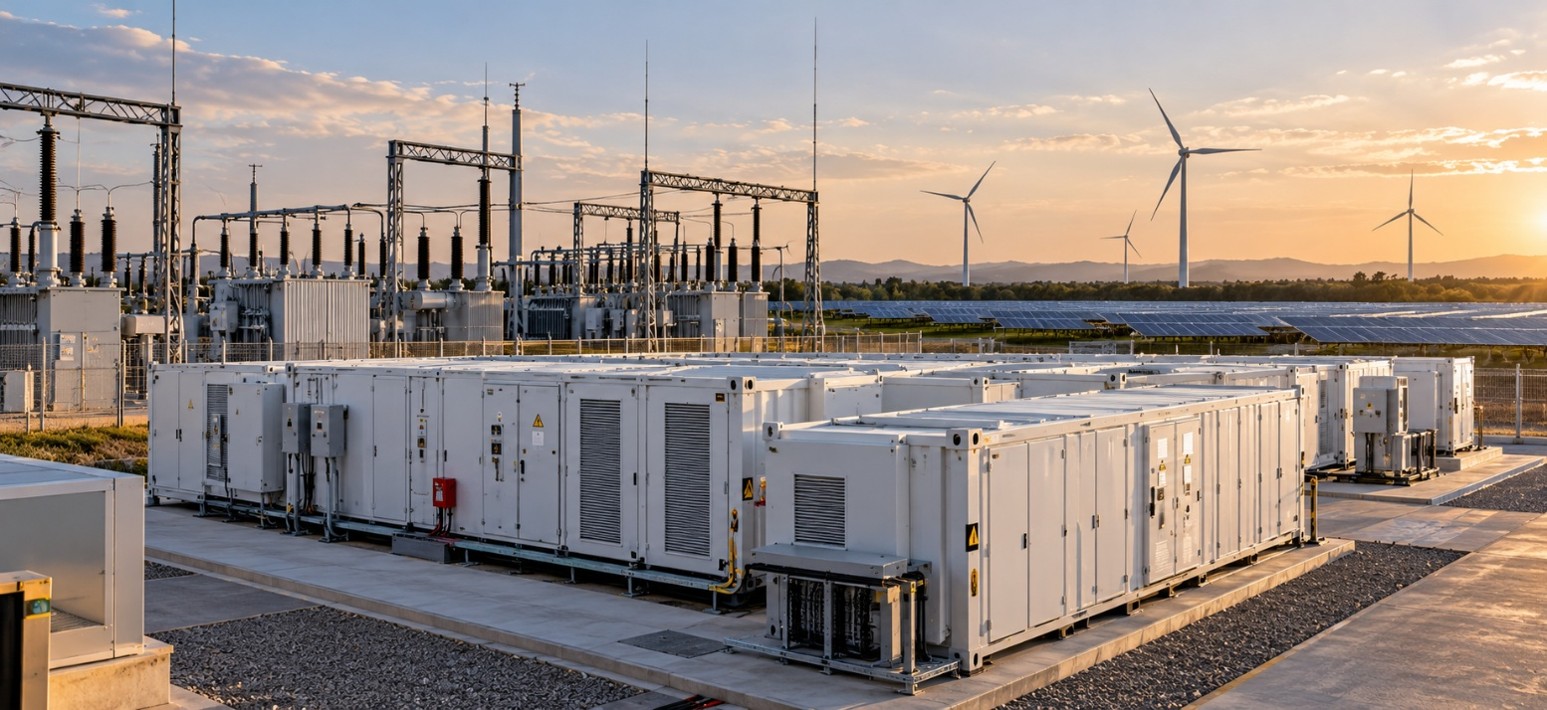
More Indian renewable energy projects now include storage. Hybrid wind-solar plants, open access projects and FDRE/round-the-clock contracts use battery energy storage systems (BESS) to shift energy into peak and non-solar hours, firm up scheduled supply, and reduce exposure to deviation charges and time-of-day tariffs.
In its roles as Lender’s Independent Engineer and Owner’s Engineer, EES has worked on several hybrid and solar-plus-storage projects involving different battery system suppliers. Reviewing these projects side by side has helped us understand where products differ, where they do not, and why supplier selection is only one part of the job.
Through the EES Learning Series, we share practical insights from our project work with developers, lenders, investors and engineers across the industry.
This article presents a basic comparison of three suppliers we have encountered. Jinko ESS (JinkoSolar), Gotion High-Tech and AmpereHour Energy. Product information is drawn exclusively from publicly available manufacturer sources. This is not a ranking. The right choice depends on the project’s use case, contract structure and risk allocation.
These Are Not the Same Kind of Company
A common mistake is to compare a cell manufacturer, a PV module manufacturer’s storage division and a system integrator as though they were the same type of business.
- • Jinko ESS is the storage arm of a PV module manufacturer. Its utility-scale products are supplied mainly as liquid-cooled DC blocks. The cell origin for a specific project should be confirmed in the supply contract.
- • Gotion High-Tech manufactures LFP cells and integrates them into packs and complete systems.
- • AmpereHour Energy is an India-based integrator. It uses third-party cells and provides its own EMS and digital QA platform.
This distinction matters during due diligence. For a cell manufacturer, the review focuses on the cell and the system design. For an integrator, the key questions are which cell is being used, which plant it comes from, and whether the cell warranty is passed through to the owner on a back-to-back basis.
Basic Technical Comparison
The comparison below covers business model, cell chemistry and format, platform offerings, thermal management, published cycle-life claims and controls.
| Parameter | Jinko ESS (JinkoSolar) | Gotion High-Tech | AmpereHour Energy |
|---|---|---|---|
| Business Model | Energy storage division of a PV module manufacturer. Residential, C&I and utility-scale systems. | Vertically integrated: LFP cell manufacturing through to packs and complete systems. Serves EV and stationary storage. | India-based BESS integrator with a hardware-agnostic architecture. Opened a 5 GWh/yr integration and manufacturing facility in Chakan, Pune. |
| Chemistry & Cell Format | Prismatic LFP. 280 Ah (SunTera G1), 306 Ah (G1 Plus), 314 Ah (SunTera G2). | Prismatic LFP. 314 Ah class in current systems. 587/588 Ah, 650 Ah and 688 Ah large-format cells. | LFP, using third-party cells. The cell OEM is chosen per project. |
| Utility-Scale Platforms | SunTera G2: 5.01 MWh per 20-ft container, 0.5P. SunTera G3: 6.25 MWh. | Grid Gen1: 5 MWh and 7 MWh containers, plus a 20-MWh solution. Grid Gen2: a 5 MW / 18.8 MWh high-voltage cascaded, grid-forming system. | Containerised DC and DC-AC blocks. Public product ratings are not published. Capacity is configured per project. |
| C&I Platforms | SunGiga liquid-cooled cabinets (roughly 215–344 kWh per cabinet). | EDGE all-in-one cabinet: 100 kW / 211 kWh. | Cabinet-based C&I systems. |
| Thermal Management | Liquid cooling (SunTera, SunGiga). | Liquid cooling. Hybrid air-liquid on the 20-MWh platform. The EDGE PCS is air-cooled. | Depends on configuration and cell OEM. Not specified in public sources. |
| Published cycle-life claims* | SunTera G3: >10,000 cycles. G1 Plus: 20-year calendar life at 1 cycle/day, 25 °C, 95% DoD. | EDGE: >8,000 cycles. New large-format cells: 10,000–12,000 cycles. | Set by the selected cell OEM and the project warranty. No system-level public figure. |
| Controls & software | Integrated BMS. SunTera is supplied as a DC block, so PCS and EMS scope depends on the contract. | Integrated BMS. Gen2 adds an AI-assisted O&M platform. | Proprietary ELINA EMS. AH-Suite digital platform for factory acceptance testing, traceability and QA. |
*Cycle-life figures are manufacturer claims measured under different test conditions, including C-rate, depth of discharge, temperature and end-of-life state of health. Some figures are cell level, while others are system level, so they cannot be compared directly. Lenders and owners should rely on the warranted state of health and energy throughput specified in the contract, rather than on datasheet cycle counts.
What Real Projects Teach Us That Datasheets Do Not
Many of the issues we encounter on site have less to do with the brand and more to do with how well the system has been specified, contracted and verified.
- 1. The cycle count on a datasheet is not the warranty. Check the warranted state-of-health curve, energy throughput cap, permitted cycles per day, C-rate, temperature window and exclusions. Then confirm that these align with the project’s actual dispatch profile.
- 2. Round-trip efficiency must be defined precisely. It can be quoted on a DC or AC basis, at the battery terminals, PCS output or point of interconnection, and with or without auxiliary and transformer losses. Most gaps between quoted and realised RTE trace back to these differences in measurement.
- 3. Indian ambient conditions affect auxiliary consumption. HVAC and chiller loads at temperatures of 45°C and above reduce net efficiency. Ask for an auxiliary consumption guarantee based on site conditions, with metering at a clearly defined point.
- 4. Safety is a system-level consideration. Ask for cell certification (IEC 62619), UL 9540A large scale fire test reports, system certification (UL 9540 / IEC 62933-5-2), gas detection, deflagration venting and fire suppression design, as well as acceptance by the local fire authority.
- 5. Interfaces cause most commissioning delays. The BMS, PCS, EMS, power plant controller and SCADA must work together. Protocol mapping (Modbus TCP, IEC 61850, IEC 60870-5-104), along with compliance with CEA grid connectivity standards and SLDC requirements, should be tested during FAT, not discovered at site.
- 6. Traceability and testing matter. Cell batch traceability, witnessed factory acceptance tests and a site capacity test protocol agreed in advance help protect both the owner and the lender.
- 7. Degradation and augmentation must be addressed. If the PPA or storage agreement requires a minimum usable capacity, the augmentation plan, and who bears its cost, must be settled in the contract.
- 8. Service and availability matter over the long term. Spare modules held in India, response times, an availability guarantee and a long-term service agreement can matter more over 10–15 years than small differences in datasheet specifications.
What the Industry Still Has to Learn
Most utility scale BESS projects in India have been commissioned only recently, so the operating record remains limited. Much of the industry’s current understanding is still based on datasheets or modelling. Four gaps need attention.
- • Limited field data under Indian conditions. There is little published operating history showing how these systems perform in Indian heat, humidity and dust across real duty cycles, including daily charging and discharging, energy arbitrage, peak shaving and high-power dispatch. Realised round-trip efficiency, auxiliary consumption and availability over several years remain largely unproven.
- • Degradation must be measured, not assumed. Actual cycles, depth of discharge, C-rates and cell temperatures should be logged and mapped against measured state of health. This is the only way to test warranty curves and financial models against operating reality, while improving sizing, augmentation planning and system design for future projects.
- • Skilled O&M personnel are scarce. BESS maintenance involves thermal-system upkeep, cell balancing, BMS alarm diagnosis, fire-system checks and safe module handling. These tasks require specific training, and few technicians in India yet have hands-on experience. Many owners still depend on suppliers for routine interventions. Structured training and certification are therefore needed.
- • Software will carry more of the value. Advanced EMS, analytics and digital monitoring are needed to optimise dispatch, track degradation, predict faults and verify warranty compliance. Owners should secure full access to raw operating data from day one, at cell level where possible, because progress on each of the areas above depends on it.
No single project can close these gaps on its own. Sharing operating experience among developers, lenders, suppliers and engineers will help the industry move forward faster. That is the purpose of this series./p>
Our View
All three suppliers offer LFP based, liquid-cooled systems that are technically capable of serving utility scale and C&I applications. In our experience, the factors that most affect project outcomes are rarely the headline specifications. They are the warranty structure, quality of integration, contractual definitions, and rigour of testing and verification. A well specified and independently verified system from a capable supplier will usually outperform a poorly specified system, regardless of brand.
For open access and hybrid projects in particular, the EMS dispatch logic, its alignment with banking rules, time-of-day (ToD) tariffs and scheduling obligations, and the integration of generation and storage deserve as much attention as the battery itself.
About EES
Excelsior Engineering Solutions (EES) is an independent engineering and technical advisory firm based in Mumbai. As Lender’s Independent Engineer (LIE) and Owner’s Engineer, EES evaluates, validates and supports solar, wind, hybrid and BESS projects for which lenders, investors and developers rely on independent technical expertise. Our perspective on storage comes from hands-on work on real projects, including technical due diligence, design and specification review, supply contract and warranty review, FAT/SAT witnessing, commissioning and performance verification. EES has worked on more than 500 projects totalling over 15 GW across more than 20 Indian states and internationally.
If you are planning, financing or acquiring a hybrid or BESS project and need an independent technical view, we would be glad to talk.
*Disclaimer
Product information in this article is drawn from publicly available manufacturer datasheets, announcements and press coverage as of October 2026 and may have changed since. It is provided for general information and does not constitute an endorsement of, or recommendation against, any manufacturer or product. Observations from project experience have been generalised and do not refer to any specific client, project or supplier. Product names and trademarks belong to their respective owners.

Please rotate youauto-rotater device to portrait mode to login.