Maharashtra's Renewable Energy & Energy Storage Policy: Storage Moves From Option to Obligation
Every new renewable project above 100 kW in the state must now be built with storage on half its capacity, as Maharashtra targets 100 GW of renewables and 100 GWh of daily storage by FY2035–36.
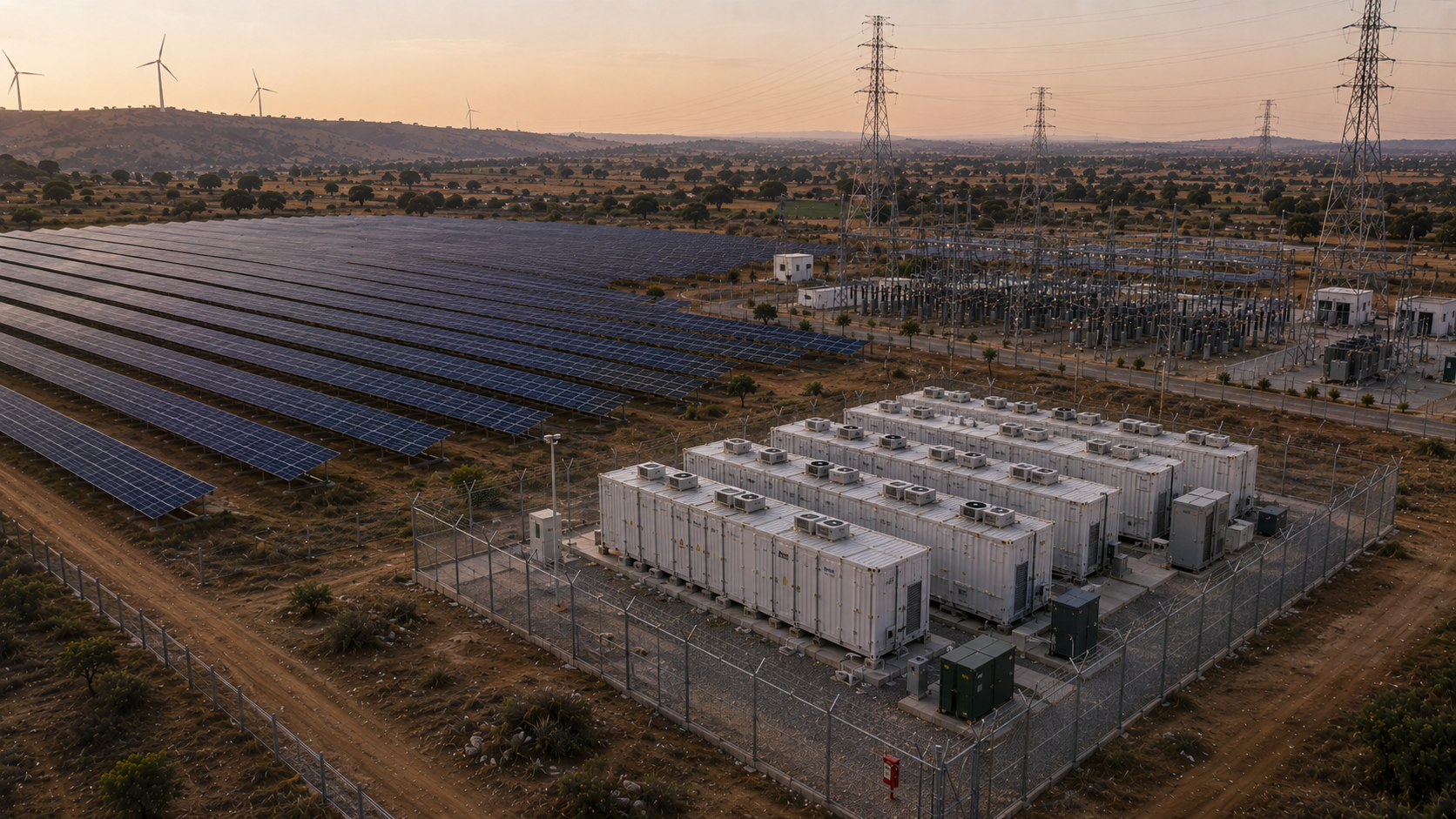
Maharashtra has made energy storage a requirement for new renewable projects rather than an option. Every project above 100 kW must now pair generation with storage, because solar and wind produce when the resource is available, not when demand peaks, and storage makes that output dispatchable. The rule has been in force since April 2026, under the state's Renewable Energy & Energy Storage Policy, which runs to March 2036 and replaces the 2020 framework.
Demand is set to nearly double within a decade
Maharashtra's electricity demand is growing faster than the system was built to serve. Peak demand rose from 20.4 GW in 2015 to a record 30.7 GW in March 2025, and electricity supplied grew from about 133 billion units in FY15 to roughly 202 billion units in FY25. On current trends, demand reaches 350–360 billion units by 2035–36, close to double the system in a decade. The policy treats this as structural growth, not a temporary spike.
Renewable generation alone cannot meet demand at this scale. Solar and wind are variable, so adding more of them without storage creates balancing and reliability problems rather than solving supply. The 2020 policy did not require storage; this one does, and that requirement runs through the whole framework.
Renewables must reach 65% of demand by 2035
The policy sets targets for 2035–36, with interim milestones for 2029–30:
The 100 GW capacity assumes a capacity utilisation factor of about 26%, and the 100 GWh of daily storage is roughly 20 GW of power at five hours. All of the demand growth over the decade is to be met from renewables, so load growth does not require new fossil capacity.
How the storage mandate works
Any new renewable project above 100 kW, whether open access, captive or rooftop, must include storage equal to 50% of its renewable capacity. The required duration is two hours through about 2029–30, rising to four hours for projects after 2031, and the minimum storage requirement will be reviewed and updated every two years.
This makes storage part of the project rather than an optional add-on. A 100 MW solar plant now carries a battery of about 50 MW and 200 MWh at four-hour duration. This changes the inverter and transformer ratings, the DC-to-AC ratio, the layout, the land footprint, and the augmentation plan that keeps usable capacity up as the battery degrades over the plant's life.
Storage is deployed in several forms
Storage is not tied to a single model. It can be co-located with generation or built standalone, placed on rural feeders and critical loads as distributed storage, or built into larger solar-plus-storage hubs of 100–250 MW near cities. The policy also allows storage to be integrated at a common pooling substation serving multiple renewable projects, subject to the applicable metering arrangements.
The build-out is phased across the system:
For non-co-located hybrid projects that use separate connectivity points, ESS is required at each connectivity point, with the minimum storage mandate based on the respective connectivity size.
The policy also sets a separate storage obligation for distribution companies. They must procure storage capacity equivalent to at least 10% of their demand by FY2035–36. At least 85% of the energy stored under this obligation must come from renewable energy sources on an annual basis.
At the grid level, MSETCL will assess storage requirements linked to grid infrastructure. The State Transmission Utility will also develop plans for large-scale grid-connected BESS projects in the 500 MW to 1,000 MW range to support grid stability and ancillary services.
As renewable capacity expands, the policy treats energy storage as critical to reliable integration of renewable energy into the grid. Storage is also considered alongside transmission infrastructure for grid stability and for reducing congestion and curtailment.
Source: Maharashtra Renewable Energy & Energy Storage Policy 2025–26 to 2035–36.

Please rotate youauto-rotater device to portrait mode to login.